Timothy Nelson is Reimagining Opera and Baltimore Audiences Are Listening
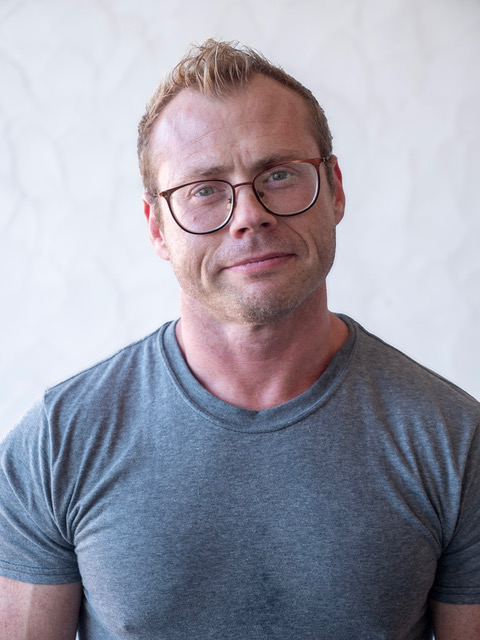
Harold BookerFor Timothy Nelson, the word “opera” barely scratches the surface of what he and his team at InSeries are trying to create.
“We make theater from music,” Nelson said. “I don’t feel what we do is any less theatrical than a play. It’s just that our medium happens to be the lyric voice instead of the spoken voice.”
That philosophy has helped transform the Washington, D.C.-based organization into one of the region’s most daring and unconventional performing arts companies, blending Western classical traditions with blues, Indian classical music, spoken word, and contemporary storytelling in ways that challenge audiences to rethink what musical theater can be.
Nelson, who became artistic director of InSeries in 2018, has built a reputation for pushing boundaries and disrupting expectations. A graduate of the Peabody Institute, he was previously celebrated internationally for innovative productions throughout Europe and the United States before returning home to help reshape the future of the art form.
According to a previous Peabody Institute profile, critics once dubbed Nelson “the future of opera,” a title that reflects both his artistic ambition and his willingness to challenge long-standing traditions surrounding the centuries-old genre.
“I hate the word opera,” Nelson admitted during a recent conversation with The Baltimore Times. “We all know what we mean when we say it, but it feels like such a paltry word for this huge thing that we do.”
Nelson believes the history of opera is deeply tied to exclusion and power structures.
“Opera was something that was about exclusion and power,” he said. “That’s very much obviously not what we want the art form to be about.”
Instead, Nelson envisions InSeries as a place where music and theater become tools for empathy, conversation, and community transformation.
The company’s mission reflects that vision: “We make theater from music, transforming artists, audiences, and community by disrupting expectations, nourishing empathy, stimulating insight, and deepening the conversation.”
For Nelson, those words were chosen carefully.
“The impact of our work starts in the lives of the artists,” he explained. “Then comes the audience, and then by extension, the community.”
Born in West Virginia and raised in Appalachia, Nelson said music became a lifeline early in life.
“As a gay, non-sporty arts boy in Appalachia, music was really the lifeline that saved my life and gave my life direction,” he said.
Although he grew up in rural Appalachia, Baltimore always remained part of his story. His mother’s family has roots in Baltimore stretching back generations, and Nelson spent summers in the city visiting relatives.
When it came time to choose a conservatory, the Peabody Institute felt like home.
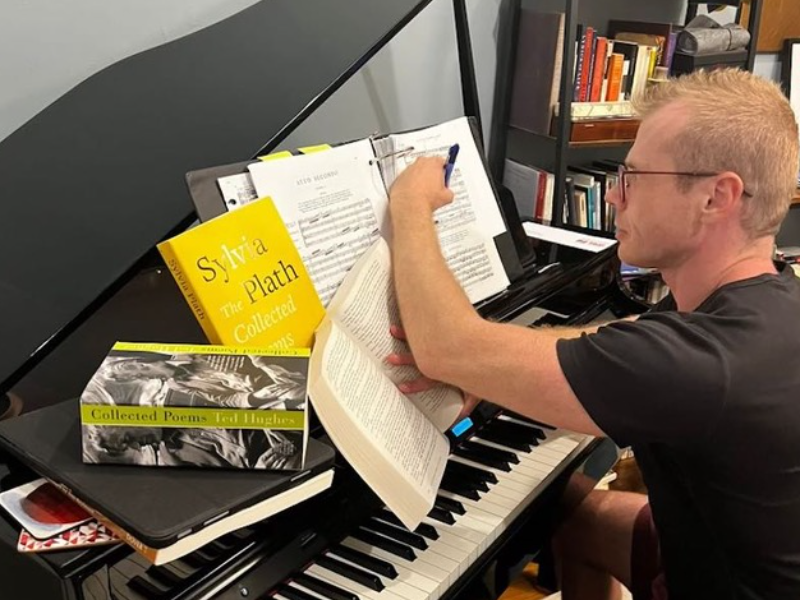
Nelson arrived in Baltimore as a composition major and quickly found his artistic path through opera and theatrical storytelling. During his freshman year at the Peabody Institute, he participated in a unique program where composition students created original operas.
“At the end of that project, they would produce an opera that you wrote,” Nelson recalled. “As an 18-year-old, I got to write this 45-minute opera, and it was like scales fell from my eyes. I never looked back.”
He later founded a small Baltimore-based company called American Opera Theater, which operated primarily out of the Theater Project in Mount Vernon.
“We did really off-the-wall amazing stuff with a shoestring,” he said.
That early experience also unexpectedly prepared him for arts administration.
“I didn’t quite appreciate the degree to which I was gaining skills in arts administration and development and marketing,” Nelson said. “All I felt was the grind of starting a company from scratch.”
Eventually, Nelson moved to Amsterdam, where he spent 13 years running the Dutch National Opera Academy and directing productions throughout Europe. Yet despite Europe’s prestige within the classical arts world, Nelson found himself longing for home.
“As an artist, we have this fetish for Europe,” he said. “But really from the moment I was there, I wanted to come back to America.”
That opportunity came in 2018 when he accepted the artistic director role at InSeries.
At the time, the company operated on a modest budget of roughly $200,000. Today, that budget has grown to approximately $1.2 million.
“It’s still small, still scrappy, still on a shoestring,” Nelson said. “But I could see from the DNA of the company that it was a place that would let me do the crazy stuff I wanted to do.”
That “crazy stuff” has included productions that blend social commentary with musical experimentation. Previous works under Nelson’s leadership have explored racism, slavery, immigration, grief, and censorship.
One recent season unintentionally centered around banned works.
“I realized about a week before we published the brochure that all of the pieces had been censored when they were written,” Nelson said. “I don’t believe those things are accidents. I feel like the universe is doing something.”
That openness to experimentation also led to Delta King’s Blues, the company’s blues-inspired production centered on legendary musician Robert Johnson.
Nelson said he first learned about Johnson after returning to the United States when an audience member handed him one of the blues artist’s albums.
“I read about his life and thought, ‘Oh my gosh, this is a total opera,’” Nelson said.
Around the same time, one of InSeries’ resident artists independently approached him with the idea of writing a production about Johnson.
“That was literally a week apart,” Nelson said. “Again, the universe is doing something.”
For Nelson, blending blues music with classical traditions reflects the company’s commitment to treating all musical forms with equal importance.
“We don’t put Western classical music higher than any other form of music in the world,” he said.
That philosophy continues with InSeries’ latest production, “Songs of Shakuntala,” which runs June 6 through June 21, with Baltimore performances scheduled June 19–21.
The production marks a particularly personal milestone for Nelson because it features his own composition, written nearly a decade ago.
“I wrote it with no thought that it would ever be performed,” he said. “I just wanted to prove to myself I could do it.”
The work combines Western classical instrumentation with Indian classical music traditions and features a small ensemble of musicians and performers, including Morehouse College alumnus Marvin, who serves in a spoken role within the production.
Nelson says the intimate scale of InSeries’ productions is intentional.
“I believe smallness has power,” he said.
Unlike major institutions such as the Metropolitan Opera, which can involve massive orchestras and casts, Nelson believes smaller productions create space for collaboration and experimentation.
“So much of our rehearsal process is spent figuring out how we make music together,” he said. “Those are conversations that get lost at scale.”
InSeries has also strengthened its connection to Baltimore audiences in recent years by bringing productions to the city.
Initially, Nelson said the decision was partly practical because many of the company’s artists live in Baltimore due to the region’s affordability compared to Washington, D.C.
But he quickly discovered Baltimore audiences offered something else.
“They’re much more diverse. They’re much younger. They’re less risk-averse,” Nelson said. “They like taking chances on weird programming.”
He believes Baltimore’s creative culture actively pushes the company to remain bold.
“Baltimore keeps us honest,” he said. “It encourages me to make risky choices because I know that’s what Baltimore audiences like.”
Nelson also praised Baltimore’s thriving arts community and its role as one of the few remaining affordable cities for artists.
“The financial realities of living in D.C. don’t allow for risk-taking,” he said. “That’s really special about Baltimore.”
Even after years abroad and nearly a decade leading a Washington-based organization, Nelson says Baltimore still feels like home.
“My body is in D.C., but my heart’s in Baltimore,” he said.
For more information about InSeries and upcoming performances, visit inseries.org.